Best Workout Tracker for People Who Hate Gym Apps (2026)
A workout tracker for people who hate gym apps is a specialized tool—usually powered by natural language processing—that prioritizes rapid data entry over flashy graphics or social feeds. These trackers allow you to log sets and reps exactly like a paper notebook or a digital notes app while automatically turning that shorthand into structured performance data. Why does this matter in 2026? Because after years of "gamified" fitness, we're seeing a massive return to minimalist utility. Research from the NIH indicates that 69% of fitness apps are abandoned within 90 days (2025), largely because the friction of tapping through menus kills the momentum of a good workout.
If you find yourself constantly opening the Notes app on your iPhone to jot down "Bench: 225 3x5" rather than dealing with a clunky dropdown menu, you aren't alone. You're part of a growing movement of lifters who want progress, not digital chores.
What is a Natural Language Workout Tracker?
Before we look at the software, let's define what we're actually talking about. A natural language workout tracker is a tool that understands your shorthand. Instead of selecting an exercise, then a weight, then a rep count from three different scrolling wheels, you just type or speak a single line. Something like "Deadlift 315 1x5" is instantly parsed by the system.
This technology bridges the gap between the speed of a pen and the power of a database. As industry experts from Digiqt note, "Voice agents and natural language models are transforming the sector by providing cost-effective, user-friendly interactions that mimic a human coach." The goal isn't to give you more to do on your phone; it's to make the phone invisible.
Why Traditional Gym Apps Kill Your Workout Momentum
Ever been in the middle of a heavy leg day, heart racing, sweat dripping, only to have your fitness app ask you to "rate your effort" or join a "community challenge" before you can log your next set? It's infuriating.
This frustration is grounded in cognitive science. During high-intensity training, your brain's executive function is heavily taxed. As Jordana Naftali, an expert in cognitive load during training, notes: "Mental fatigue induced by cognitive load can impair physical performance." When an app forces you to navigate a cluttered interface, it's literally stealing the focus you need for your next set.
The Problem with "Smart" Design
Traditional apps are built by designers who want to maximize "time in app." But for a lifter, the goal is the exact opposite. You want to spend as little time as possible looking at a screen.
- Too many buttons: High-precision touch targets are hard to hit with shaky hands.
- Gamification fatigue: You don't need a digital badge for doing squats; you just need to know if you're getting stronger.
- The Loading Circle: In a gym with bad Wi-Fi, a cloud-dependent app is a brick.
According to data from Lucid.Now (2025), weekly retention for these complex fitness apps drops to a staggering 8.5% after just seven days. Users don't quit because they stop working out—they quit because the digital overhead simply isn't worth the trouble.
The Notes App Trap: Why Speed Doesn't Always Equal Progress
If traditional apps are so bad, why doesn't everyone just use the Notes app or a physical notebook? Many do. The Notes app is the undisputed king of "simple gym tracking app iPhone" searches for a reason. It's instant. It's flexible. It never asks for a subscription.
But the Notes app has a ceiling.
After six months of logging, how do you know if your volume on chest day is increasing? How do you calculate your 1-Rep Max (1RM) for overhead press without doing manual math on a calculator? Paper and simple text files are great for recording, but they are terrible for analysis. They are static.
Key Takeaway: The ideal tracker for an "app hater" must provide the zero-friction entry of a note with the automated graphing of a professional database.
How AI Transforms Your Shorthand Into Performance Data
In 2026, the best workout tracker for people who hate gym apps uses background automation to solve the data entry problem. This is a massive shift from how things were done just a few years ago.
When you type "Squat 100kg 5, 5, 5," the app shouldn't just store that text. It should recognize that "100kg" is the load and "5, 5, 5" are the sets and reps. This allows the software to build volume charts and estimated 1RM graphs automatically.
This is why natural language workout trackers are winning. You keep your shorthand. The app does the work. No more fighting with UI components that were clearly designed for someone sitting on a couch, not someone standing in a squat rack.
5 Best Alternatives to Form-Heavy Fitness Trackers in 2026
If you're ready to move beyond basic notes...
| Tracker | Best For | Input Method | Social Features |
|---|---|---|---|
| Hevy | Polished Minimalism | Tap / Templates | Optional / Low |
| Strong | Data Purists | Tap / Grid | None |
| Gym Note Plus | Notes App Loyalists | Natural Language / Text | None |
| FitNotes | Utilitarian Android Users | List Selection | None |
1. Hevy: The Balanced Modern Choice
Hevy has become the gold standard for a reason. It's clean, fast, and stays out of your way. While it still uses a template-based system rather than pure text, it remembers your previous weight and reps for every exercise. This "ghost filling" feature means you often only have to tap a single checkmark to log a set. It's efficient, though it still requires a bit of setup time to build your routines.
2. Strong: The No-Nonsense Veteran
Strong has been around forever, and for good reason. It doesn't have a social feed. It doesn't have "influencer" workouts. It's just a grid. For users who want data sovereignty, Strong allows for easy CSV exports. If you want to own your data and maybe play with it in Excel later, this is a solid choice.
3. Gym Note Plus: The Note-Taking Evolution
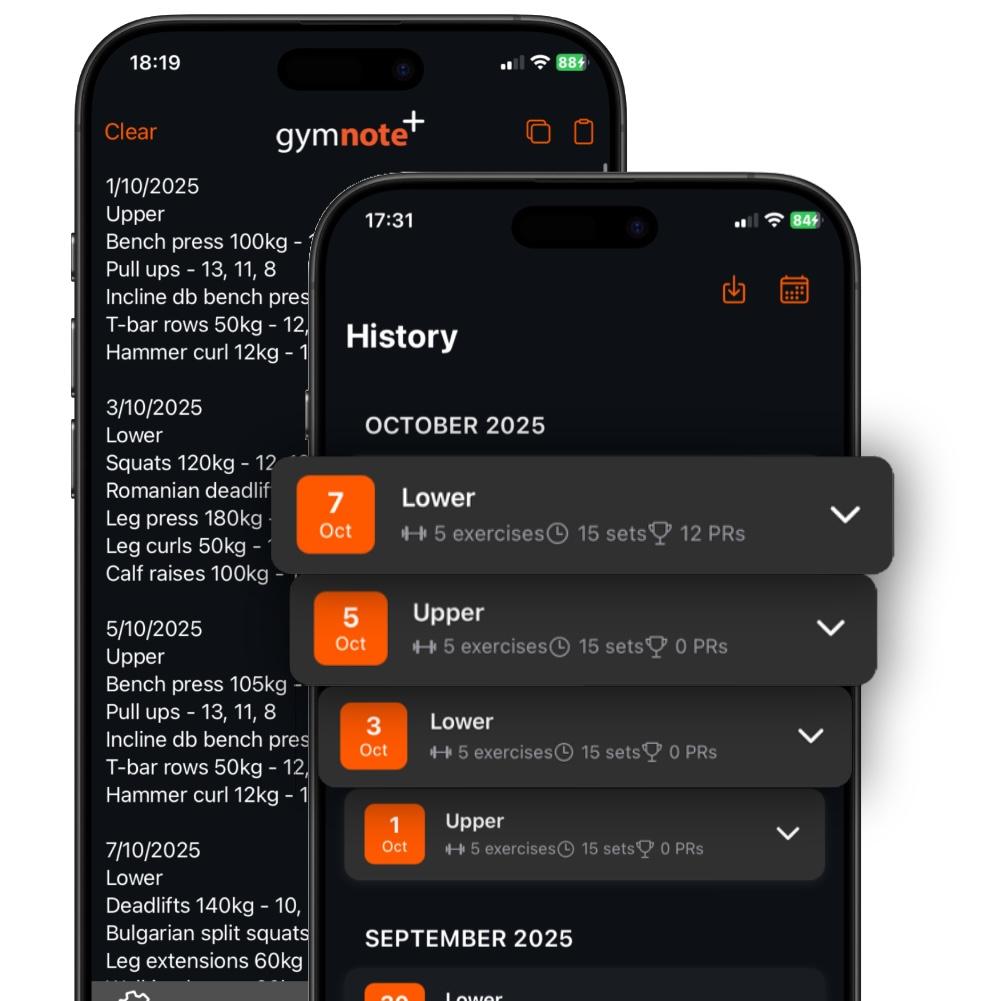
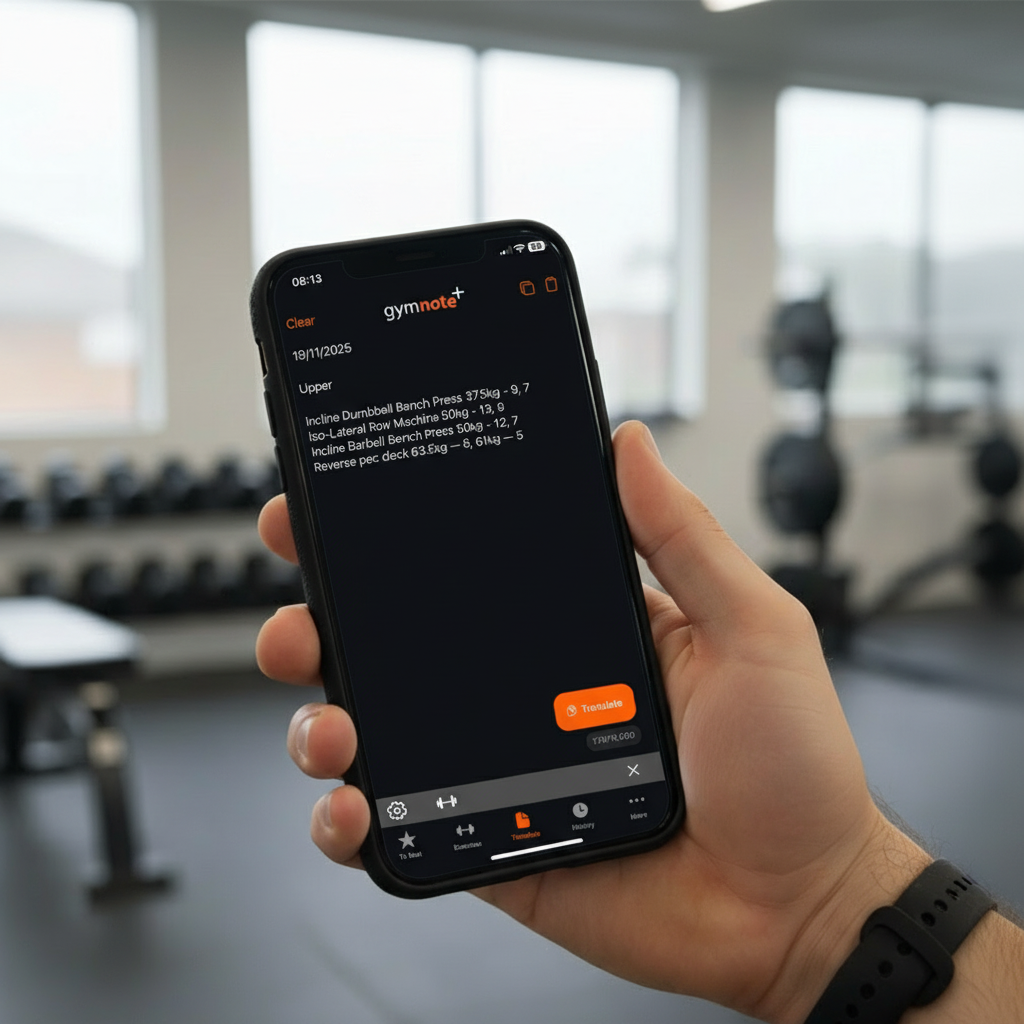
One option that takes a completely different approach is Gym Note Plus. It's specifically built for the person who loves the Notes app but hates that it can't draw graphs. Instead of changing how you log, it lets you keep writing your workouts exactly how you always have.
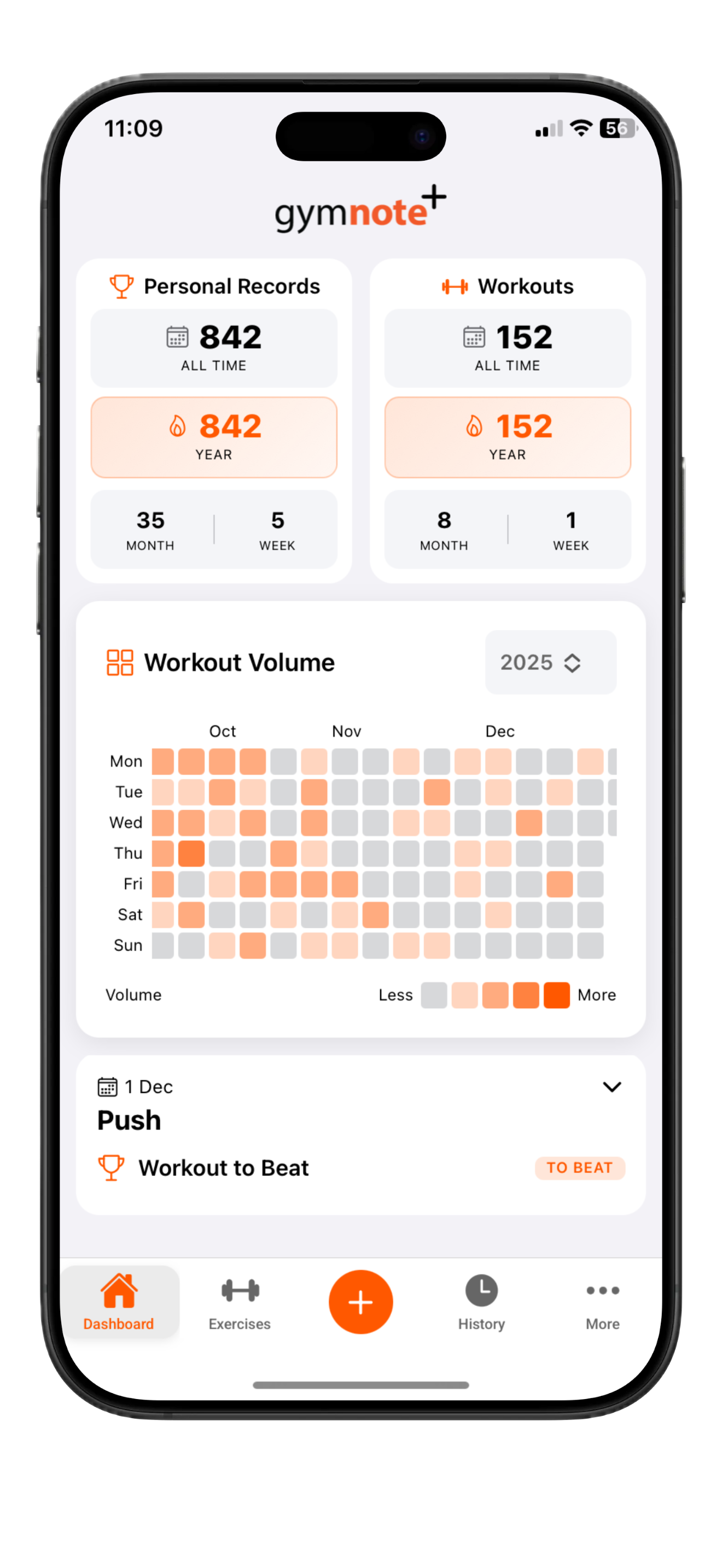
It’s the only workout tracker that transforms natural language notes into structured data automatically. You just type your sets in your own shorthand, and it creates the charts for you. No dropdowns, no menus, no friction. It offers the speed of note-taking with the power of a dedicated tracker. It's a great choice if you want to see if you're actually getting stronger with graphs that matter—not just "workout streaks" that don't tell you anything about your actual progress.
4. FitNotes (Android Only)
If you’re on Android and you think modern apps "look like garbage" because of over-design, FitNotes is for you. It looks like a spreadsheet from 2014, and that is its greatest strength. It is completely ad-free and focuses entirely on the efficient input of integers. It is a purely functional tool with zero gamification.
Getting Started: Transitioning from Notes to Structured Logs
Making the switch doesn't have to be a project. If you're moving from a pile of messy notes to a more structured system, keep these three steps in mind.
- Don't import everything at once. You don't need your workout history from 2022. Just start with your current week's numbers.
- Pick your shorthand and stick to it. Whether you prefer "Weight x Reps" or "Reps @ Weight," keep it consistent so the automation can learn your style faster.
- Use the web when possible. Some apps, like Hevy or Gym Note Plus, have web versions. Use a real keyboard to set up your routines or review your progress on a Sunday night. It's much less stressful than doing it on a small screen in a busy gym.
According to research from the University of Colorado, the act of tracking itself can influence health outcomes by providing a sense of agency and objective feedback. But that only works if you actually do it.
As Dr. Williams notes in a recent health study, "Exercise can boost your memory, but you can't rely on your memory to track a year of progressive overload." You need a record. But that record shouldn't be a source of stress.
Find a tool that fits your brain. If you hate gym apps, stop using them. Go back to basics. Use your notes, use your shorthand, and let the technology work for you in the background. The best tracker is the one that becomes invisible, leaving you with nothing but the weights and your own focus.
Your shorthand becomes structured data instantly. No more scrolling. No more clicking. Just lifting. Isn't that what we're here for?
Josh Ibbotson
Josh is the creator of Gym Note Plus, building tools that make workout tracking as simple as taking notes.
Ready to try it out?
Download Gym Note Plus and start tracking your workouts the way you want.
Download on App Store